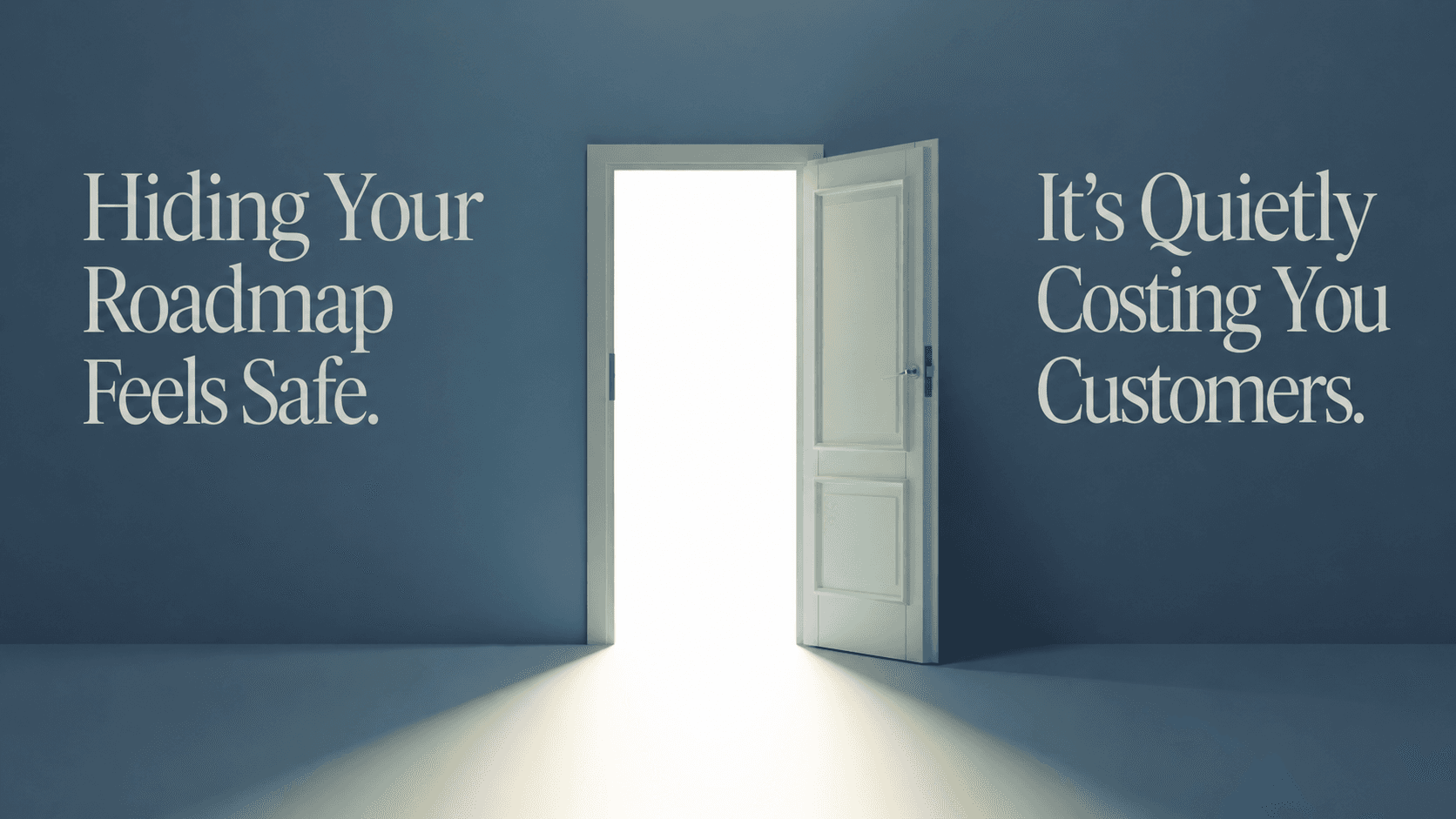
Hiding Your Roadmap Feels Safe. It's Quietly Costing You Customers.
A private roadmap feels like the cautious choice. But while you protect yourself, customers assume the worst. Here's why a public roadmap is the safer bet.
Keeping your roadmap private feels like the safe move. No promises to break, no pressure, no one watching you fall behind. But that quiet comfort has a price you never see on an invoice. While you hold your plans close, your customers are left guessing, and people almost never guess in your favor. The roadmap you're hiding to protect yourself may be the very thing pushing customers toward the exit.
What a Private Roadmap Really Signals to Customers
You think a private roadmap says, "We're being careful." Your customers hear something completely different.
When people send feedback and get silence in return, they don't picture you heads-down, building the exact thing they asked for. They assume you didn't read it, didn't care, or worse, that the product is drifting. A hidden roadmap turns every unanswered request into a small, nagging question: Did they even see this? Is anyone still home? Should I start looking for an alternative?
Here's the trap. You know your roadmap is packed. You know the next three months are spoken for. But your customers can't see any of it, so to them, it may as well be a blank page. Silence doesn't read as caution. It reads as neglect. And a customer who feels neglected has already started writing the breakup email in their head.
This is the gap that quietly kills retention: the distance between how busy you actually are and how busy you appear. A private roadmap keeps that gap wide open.
Why Hiding Your Roadmap Feels Safe (But Isn't)
The fear is completely understandable. If you publish your plans, people might hold you to them. You might commit to something and slip. You might have to tell a paying customer "no" where everyone can see it. So you keep the roadmap behind the curtain, and that feels like protection.
But think about it like a locked room in a house you're trying to sell. You believe you're guarding something valuable. Buyers walking through just wonder what you're hiding. The closed door doesn't create confidence. It creates suspicion. An open door, even to an unfinished room, almost always reads as more honest.
A private roadmap protects you from one small, manageable risk (being occasionally wrong in public) while quietly exposing you to a far larger one: looking like a product that has stopped moving. One risk costs you a moment of awkwardness. The other costs you the customer. Safe on the surface, expensive underneath.
There's a name for the instinct at work here. Psychologists call it loss aversion: we feel the sting of a visible mistake far more sharply than we feel the slow bleed of an invisible one. Hiding your roadmap soothes the loud fear (public failure) while feeding the silent one (customer drift). You optimize for the wrong loss.
The Hidden Cost of Silence
Silence is never neutral. It is not a blank space that customers patiently wait inside. When you don't fill that space with information, customers fill it themselves, and the story they tell is rarely generous.
Customers Assume the Worst
People are wired to close open loops, and they do it with the worst available material. No updates? They read it as no work. No reply to their request? They read it as no listening. You never said any of that, but silence said it for you, loudly. In the absence of facts, fear writes the narrative.
You Lose the Chance to Say "Not Yet"
A hidden roadmap traps you in a brutal binary: a hard yes or an uncomfortable no. But the most honest, most common answer in product lives in the gray middle: "not yet," "we're weighing it," "great idea, wrong quarter." Without a public surface, those nuanced answers have nowhere to live, so they go unsaid. The request vanishes into a black hole, and the person who sent it learns a quiet lesson: don't bother next time.
Churn Happens Without a Sound
This is the part that hurts most. People rarely announce that they're leaving. They don't file a complaint or reply to your cancellation survey. They simply drift. They stop opening your emails. They log in less, then not at all. One day the subscription lapses and you never even got the chance to fight for them. By the time the dashboard shows the dip, the trust was lost weeks ago, in all the silence they couldn't see past. Hidden roadmaps don't cause loud failures. They cause quiet, untraceable ones, which are the hardest kind to fix because you never learn why.
How a Public Roadmap Builds Trust
Trust isn't built only in the moment you ship. It's built in every small moment a customer can see that their voice landed somewhere real and is moving forward.
A public roadmap turns feedback into a visible loop. Someone submits a request, watches it get acknowledged, sees it move from "under review" to "planned" to "in progress," and finally to "shipped." At each step, they feel something simple but deeply powerful: they're actually listening to me. That feeling builds more loyalty than the feature itself ever will.
It works because it replaces guessing with proof. Instead of wondering whether you care, customers get to watch you care, in the open, week after week. Honesty you can see beats reassurance you have to take on faith. This is the same instinct behind the "build in public" movement: visibility itself is a form of credibility. A public board, paired with clear feature requests and voting, shows every customer exactly where their idea stands and how many others want the same thing. That visibility does two jobs at once: it keeps customers engaged, and it quietly tells them you have nothing to hide.
There's a strategic bonus, too. A public roadmap turns your customers into a free, always-on prioritization engine. Instead of guessing what matters, you watch what gets votes. The loudest request and the most important request are rarely the same thing, and votes help you tell them apart before you burn a sprint on the wrong one.
How to Open Up Your Roadmap Without Fear
Going public does not mean exposing every messy internal detail, every abandoned experiment, or every dependency. It means sharing just enough to replace silence with signal. Here's how to do it without the dread.
Start With Three Simple Columns
You don't need a sophisticated system to begin. Three columns will carry you a long way: Planned, In Progress, and Shipped. That's enough to show customers real momentum without locking yourself into dates you can't guarantee. Resist the urge to over-engineer it. A simple board you actually update beats a beautiful one you abandon.
Make "No" and "Not Now" Normal
Saying no in public sounds terrifying, but done well, it's one of the most trust-building moves you have. A short, kind, honest note ("This doesn't fit our direction right now, and here's why") respects the person infinitely more than silence ever could. It also protects your roadmap from becoming a graveyard of vague promises. Counterintuitively, when "no" is a normal, visible answer, customers trust your "yes" far more, because they know it actually means something.
Close the Loop When You Ship
This is the moment that compounds. When you ship something a customer asked for, mark it done and tell the people who requested it. A quick changelog update turns a routine release into a visible promise kept. People remember kept promises, and they tell others about them. One closed loop often generates the next ten pieces of feedback, because customers learn that talking to you actually changes the product.
Share Progress, Not Promises
You don't owe anyone a hard deadline. You owe them honesty about direction. Share what you're building and why it matters, and keep the exact timing flexible. "We're working on this now" ages gracefully; "shipping March 14th" becomes a liability the moment something slips. Progress builds trust steadily. A broken date erases it instantly. When in doubt, communicate movement, not dates.
Public vs. Private Roadmap: A Quick Comparison
| Question | Private Roadmap | Public Roadmap |
|---|---|---|
| What customers feel | Uncertainty, doubt | Clarity, confidence |
| Where feedback goes | Into a black hole | Into a visible loop |
| Saying "not yet" | Awkward or skipped entirely | Normal and expected |
| Prioritization input | Guesswork and gut feel | Real votes from real users |
| Effect on churn | Quiet, untraceable | Easier to catch early |
| Overall message | "Maybe they stopped building" | "They're listening and shipping" |
The private column isn't actually safer. It's just quieter about its risks, which is a very different thing.
The Trust Compounds Over Time
Here's the part most founders miss. A public roadmap isn't a one-time gesture; it's an asset that grows more valuable the longer you keep it. Every closed loop teaches customers that feedback is worth giving. That brings more feedback, which sharpens your prioritization, which leads to better releases, which earns more trust, and the whole flywheel turns a little faster. Hidden roadmaps can't compound, because nobody can see the wins. Public ones turn every shipped feature into proof you can point back to for years.
Frequently Asked Questions
Won't competitors copy my roadmap?
Most competitors aren't sitting around waiting for your roadmap to tell them what to build. They have their own backlog and their own opinions. And here's the deeper truth: copying a feature is easy, but copying the trust you've built with customers is nearly impossible. A competitor can ship the same checkbox; they can't ship your relationship. The upside of transparency almost always outweighs the small risk of being studied.
What if I miss a date I shared?
The cleanest answer is to not share hard dates in the first place. Share direction and visible progress instead. When your roadmap communicates "what" and "why" rather than "exactly when," a delay becomes a normal status update rather than a broken promise. If you do slip on something you announced, say so early and plainly. Customers forgive honesty far faster than they forgive silence.
Should I show every single feature request?
No, and you shouldn't try. A public roadmap is a curated view of your direction, not a raw dump of every idea that lands in your inbox. Show the themes and the work you've genuinely committed to. Let a separate feedback board hold the long tail of requests where customers can vote, so the roadmap stays focused while no idea gets lost.
How often should I update it?
Often enough that it never once looks abandoned. You don't need a daily overhaul. Even a small weekly nudge (one status moved, one item shipped) signals that the product is alive and moving. Consistency matters more than volume. A roadmap that updates a little every week builds more trust than one that gets a massive update twice a year.
Is a public roadmap right for a brand-new product?
Yes, and arguably it matters even more early on. When you're new, trust is your single scarcest resource, and you have no track record to lean on. Showing prospective customers that you listen, prioritize openly, and ship what you say is one of the fastest ways to earn credibility before you've built a reputation. The earlier you start the loop, the sooner it begins to compound.
A hidden roadmap feels safe precisely because its risks stay invisible, but invisible risks are the ones that quietly cost you the most. Open the door, show your work, and let customers watch you listen. The companies people trust most aren't the ones that never get anything wrong; they're the ones brave enough to build in plain sight. Start building your public roadmap with Tembrio.